Here’s a picture of the “orchard” area of the yard. The tree in bloom is the italian plum tree. I never get anything off of this tree because the darned squirrels always get to them first. They seem to take one bite out of each plum then proceed to throw it away. In late summer, that corner is a minefield of plums with a bite taken out of it. The Meyer lemon tree is showing the winter bounty. I get 2 crops a year off of this lovely tree. I normally leave the lemons on the tree until I need one. Of course, this often means that I will still have the previous crop on the tree when the new crop shows up. To the left of the lemon tree is a little apple tree. And no, I don’t get anything off of this tree either. Yup. The squirrels again.

Old (L) vs. New (R)
But believe it or not, this post isn’t about the season spring. It’s about the spring on the HansenCraft miniSpinner brake. Did you know that there is a new spring in town?
The miniSpinners have always had a fairly strong pull while spinning, especially with the Woolee Winder. There has been many creative ways of countering the pull, from lacing the yarn around the opposite arm to installing a cup hook on the flyer, opposite of the stationary eye of the Woolee Winder.
It would appear that Kevin has fixed this problem by changing to a smaller spring. You can see the 2 springs side by side in the photo on the right. The old spring is about 1″ long and the new one is only half the size. This lighter spring has made all the difference in the world. It is like a new machine and I have fallen in love with my miniSpinner all over again! Is it possible to be even more in love? The answer is a resounding YES!
I’m not quite sure when he made the change, but you can tell by comparing your spring with the 2 shown. If you have the old spring, you can contact Kevin for a new one. They are $15 each.
Now, I’m going to show you how to change out the spring. It’s easy, once you’ve figured it out, but it’s not entirely intuitive. Hopefully, the next series of picture will help walk you through the steps in swapping it out. Click on any of the thumbnails to enlarge.

Spring Detail
First, I’m going to show you the detail of the spring. Take a close look at end of the spring that is not tied to the fishing wire [Spring Detail]. There is an open end. This is how you will slip it off (and back on later) of the eye on the miniSpinner. My needle threader is pointing at the open end. (Please ignore the ugly cuticles. I really need a manicure.)
Loosen the tension on the brake completely. (Turn the knob on the right of the miniSpinner toward you and gently keep tension on the brake band. You will be pulling more of the white string out of the base of the miniSpinner. You won’t be able to pull it completely off, which is good because you don’t want to. Just loosen it so you have more room to work with.

Lark's Head Knot
Now, take a close look at how the brake band is attached to the white string. I’m sorry, but this is a very fuzzy picture. The brake band is attached to the string with a Lark’s Head knot. You will need to open the Lark’s Head to remove the old brake band.
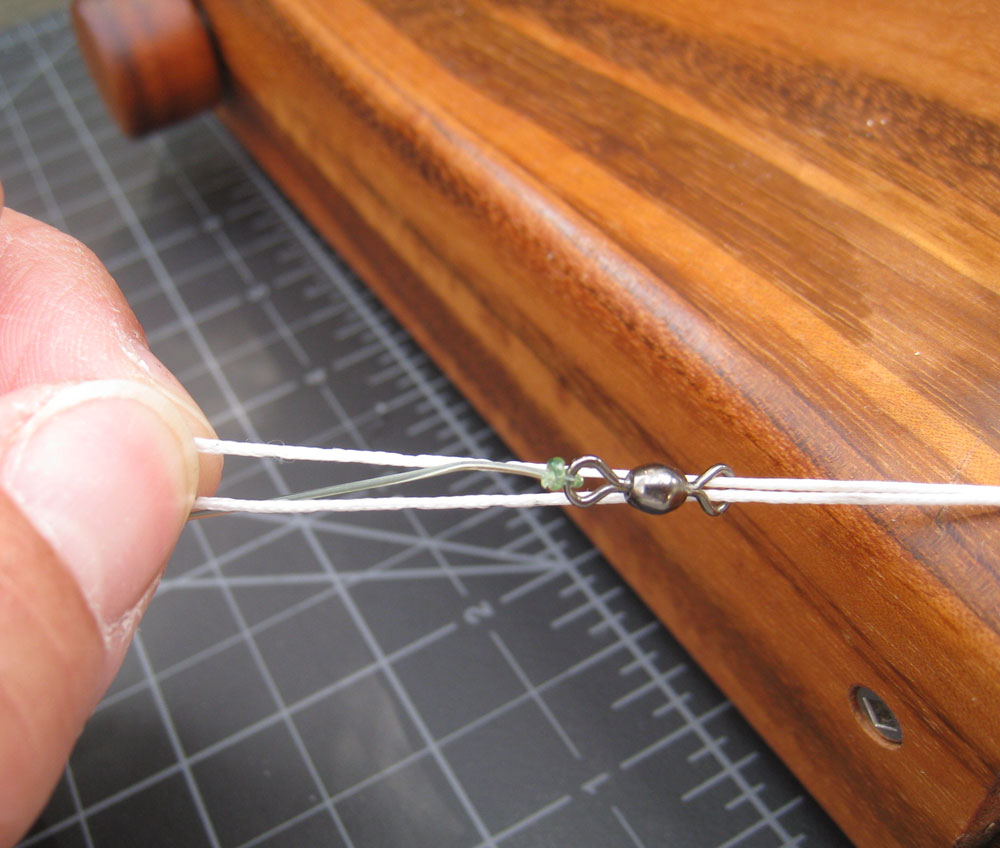
1. Pull to openÂ
To open the knot, pull on the end of the knot (the end loop) [1]. And slide the eye down the length of the white string until the loop is large enough to pull the rest of the brake band through [2].

2. Pull through
Here’s what it looks like once you’ve pulled the spring though. The white string is threaded through one of the eyes of the fishing lure doodad [3]. (Since I don’t fish nor make lures, I don’t know the name of that fishing part. Now, slip the old brake completely off the white string.
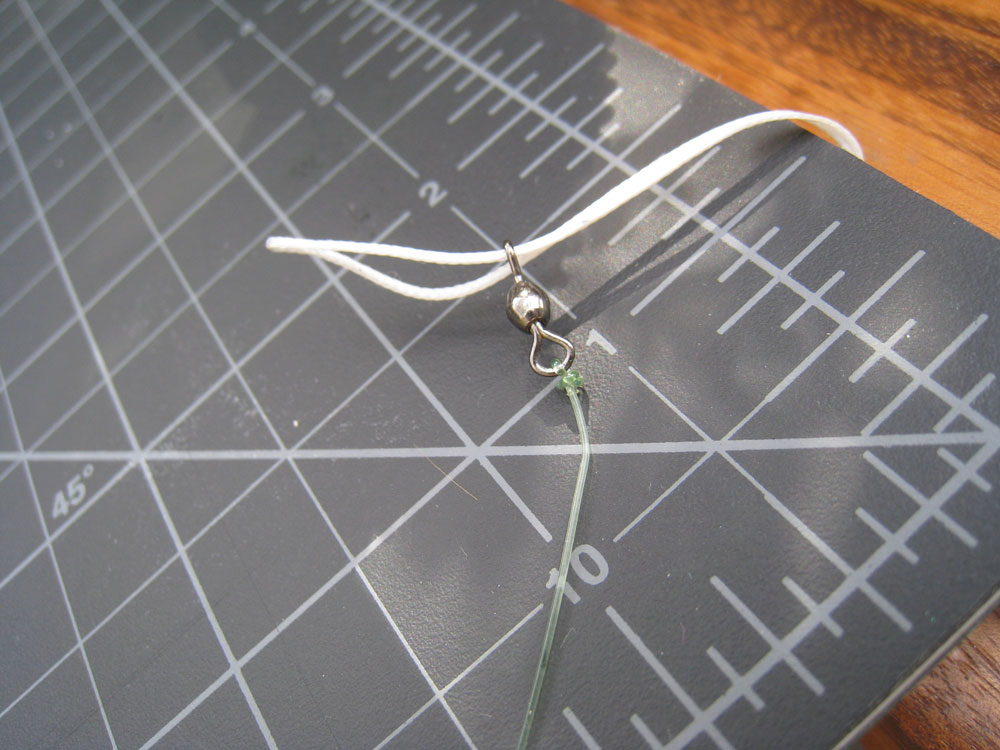
3. Unknotted
Congratulations!
You’ve just removed the old brake. Installing the new brake with the lighter spring, you work in reverse.

4. Thread
Now, you need to thread the white string through that little eye. I’ve found my needle threading to be really handy here. Poke the threader through the eye, insert the white string and pull the string through the eye.

Photo 5. Pull through
Slide the eye down the white string until the loop is long enough to pull the spring end of the brake through. Now, snug it up until it looks like the Lark’s Head Knot photo above.
Now, attach the spring to the eye at the base of the miniSpinner.
Voila! Easy, no? Yeah, I say that now. I spent 15 minutes staring at the loosened Lark’s Head Knot and couldn’t figure out how the heck to remove the brake. Kevin had explained it to me at Madrona. It was so clear then, but once I got home, I couldn’t for the life of me figure it out.
My friend Gail gave me a hint — “pull through” — that rang a bell and I was able to change it out in 30 seconds. Sometimes, you just need a mental picture.
I hope this little pictorial helps.