Random thoughts of a fiber enthusiast - mostly fiber related, sometimes coherent

Category: Knit Page 42 of 88

Flat Feet — Part II

Socks0804 - with leftover flats Socks0804 — washed/unwashed

Flat Feet socks are done!

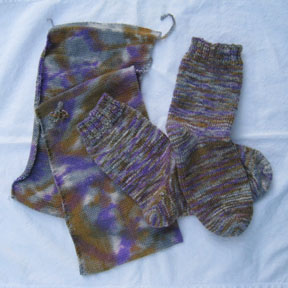
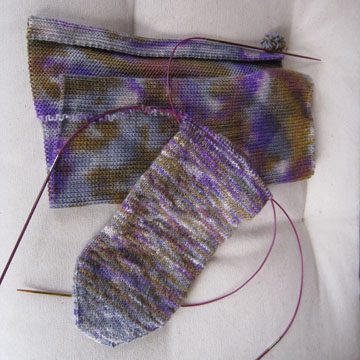
On the left are the socks in their pre-blocked stated, along with the remaining flats. The socks weigh about 30g each, leaving about 2 – 25g flats for a pair of footlets (or a scant 6″ each). Editor’s Note: I wear US Size 6 / EUR Size 37 shoes (when wearing socks). I also prefer short socks (4-6″ above ankle bone). So your personal mileage will vary, depending on your foot size. There is definitely enough yarn for average sized feet. This is a guess, since I don’t really know what “average” is.

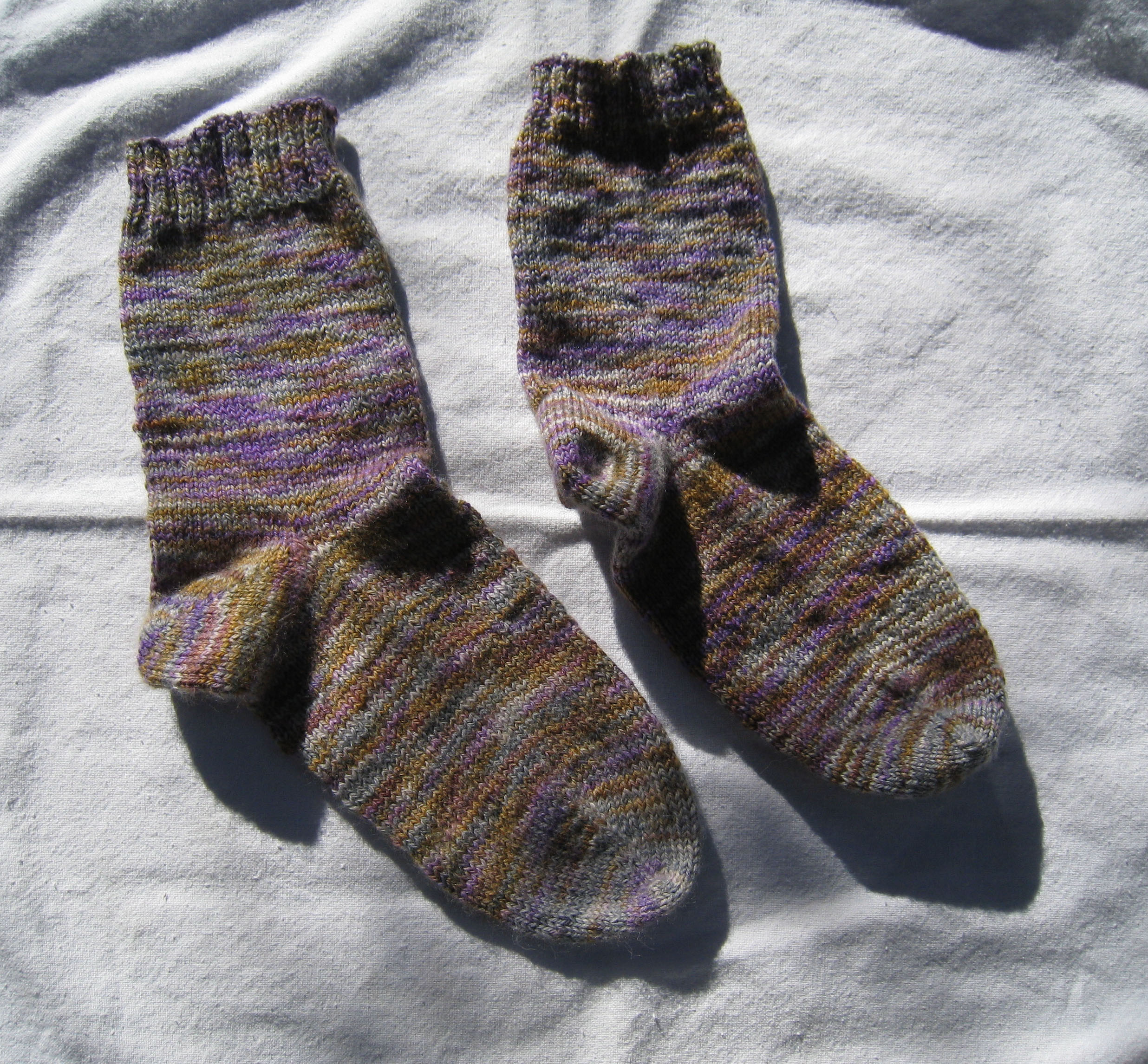
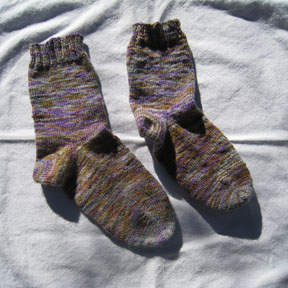
In the photo on the right, I have a sock (left) that has had a nice hot bath in Soak, and hung up to dry overnight; and one unwashed sock (right). You can see that the sock grew slightly, and most of the texture has been removed by its hot soak in the bath. Had I used a sock blocker, I’m sure that all the texture would have been removed. But since I don’t own any sock blockers, this will have to suffice.

Update: Grace said that she couldn’t see the details on the pre/post blocking well, so I have included a full sized photo.

Some additional notes and thoughts on knitting these socks:

  • I finally read all of the fine print on the tag that came along with the Flat Feet. They recommended US #3 (3.25mm) needles with a gauge of 8 spi. They must knit very tight or I’m a very loose knitter. I used US #0 (2.00mm) needles to achieve a post block gauge of 8.5 spi. As I said in my earlier post, I couldn’t accurately measure my gauge pre-blocking due to the puckering effect of my knitted fabric. I had to go by look and feel. But if you force me to give you a number, I’d say it was about 9.5 spi.
  • I knitted the first sock with my KnitPicks Harmony Wood needles. I have to tell you that it was a chore. The combination of the extra pointy ends on the KnitPicks needles and the knit then unraveled yarn made for a lot of swearing when I split the yarn. I switched to my Addi Turbos (regular, not lace) for the second sock, and all was well. No more splitting the yarn. I was able to go back to mindless knitting while I did other things. Don’t get me wrong. This is not the fault of neither the KnitPicks needles nor the Flat Feet yarn. It’s just a case of wrong equipment for the task. You’ve been warned.
  • I did more research on the knit-dye-rip-reknit thing, and found that this technique was first published by Rebekah Younger in a July 1995 issue (p. 68) of Threads, not invented by Nancy, as I stated in my earlier post.

I’m very pleased with this pair of socks. It has given me some wonderful ideas. Fortuitously, my sister just bought a knitting machine, and has offered to put my niece to work on knitting some blanks. Perhaps I can get some sock blanks for further experimentation. Maybe I can even knit some lace shawls.

Final Project Notes:

Yarn: Flat Feet by Conjoined Creations
Needles: US #0 (2 mm); KnitPicks and Addi Turbos
Gauge: 8.5 spi
Pattern: Variation on my generic toe-up socks with turkish cast on; increased up to 64 sts; yarn-over short row heel over 50%; and sewn bind-off.
Flat Feet!

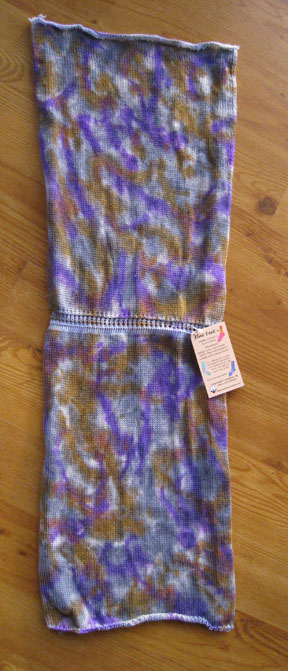
Flat FeetI bought a couple of (what? Can’t call them skeins. Can’t call them blanks, because they’ve already been painted. Sheets?) Flat Feet from Conjoined Creations at Madrona Fiber Arts Winter Retreat.

This is flat #1 (term used at their website). I was curious to see how the random colors will work out, and the purple makes me happy.

Flat Feet is a take off of Nancy‘s idea of knitting sock yarn into fabric on a knitting machine, then dyeing the fabric. You then unravel the yarn and start knitting right off of the fabric.

Flat Feet is divided into 2 separate sections by a few rows of knitted lace weight yarn (acrylic? polyester? nylon? Whatever it is, it doesn’t take dye the same way as the sock yarn). There’s a row or 2 of the lace weight yarn on both ends as well. That’s her cutting line.

Each section is 15″ long and about 11-12″ wide. I’m not sure how much yardage that actually comes out to. I was able to knit the foot out of 5.5″. I have a US size 5.5/6 foot (8.75″/22cm big toe to heel). I should have enough to make a pair of regular socks and perhaps a pair of tennis socks out of each flat.

The knitting is a bit different. The resulting fabric, as you are knitting it, is sort of like handling seersucker fabric. There is definitely texture there. The instructions says that it will all block out after the wash, and I have no reason not to believe this to be true.

Unfortunately, it’s a bit to figure out your proper gauge with this yarn, due to the nature of the crinkles. The instructions that came with the flat suggested US #3, but there was no way that would work for me. I’m using US #0 (2.0 mm). My guess is that the resulting spi is 7.5 because the sock is over 64 stitches, just like this pair of socks.

I leave you with a photo of the socks in progress. You can see the shadows cast by the texture in the fabric in this picture.

Flat Feet in progress

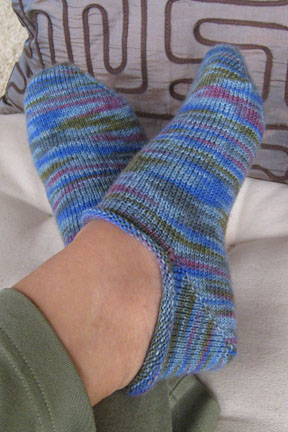
Tennis Socks, Take 2

Socks 0803 - Tennis Socks

Take 2 on the tennis socks pattern. Trying out a few more variations on my original pattern.

Variation #1: I worked the short row heel on 60% of the stitches, instead of my normal 50%. I’m not sure how I like these. I didn’t take into account of how much deeper 60% would be and started the heel at my normal place. As you can see, the sock is a bit long and the heel a bit pointy. If I’m to do this again, I would want to start the heel about 0.25″ sooner, and perhaps stop earlier. (I normally leave 1/3 of the heel stitches unworked before increasing again. I may want to try 1/3 +2 stitches unworked.)

Variation #2: I divided the cuff by working the front over 60% of the stitches, and the back (heel portion) over 40% of the stitches. This is more like how the commercial tennis socks are made. I like this. Definitely a keeper.

Yarn: Regia Kaffe Fassett #4250
Needles:US #0 (2 mm)
Gauge: 8 spi
Pattern: Variation on my generic toe-up socks with figure 8 cast on; increased up to 72 sts; short row heel over 60%; front cuff over 60%, heel cuff over 40%; and sewn bind-off.

Page 42 of 88

Powered by WordPress & Theme by Anders Norén