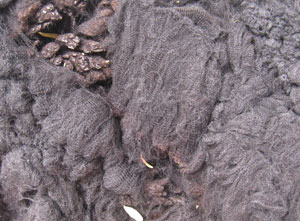
I spent the weekend washing fleece. When I was able to finish up the California Red on Saturday afternoon, I got over confident and thought that I finish both the CVM and the rest of Jill on Sunday, if I got going nice and early. Did I say I got over confident? I didn’t even finish the CVM until Monday.
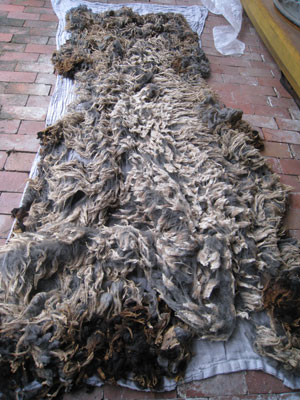
This is Badger. Badger is a CVM from The White Barn Farm. This is Badger’s first shearing.
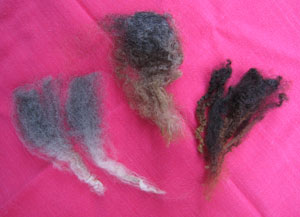 The fleece is about 6 pounds. As you can see from the above picture there are dark areas in addition to the grey. In the picture at left, I’ve pulled out 3 different locks (washed). Yes, the colors are that different. The light grey with creamy tips make up the bulk of the fleece (back). There are also some dark brown/near black and somewhere in between. The are even more variations in the fleece, but they fall into these 3 general color groups. If I try to separate them all out, I’ll go mad.
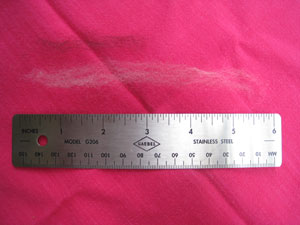 And if you look at picture of both front and back of the fleece from The White Barn Farm’s website (first link), you’ll see that the front/back are 2 completely different colors. What’s interesting is that those are not bleached tips. There are 2 staple lengths in the fleece! (see photo at right) The creamy tip is actually a white all the way through. It is about 6″ long. The grey is much darker, once the white fiber has been pulled out. It is about 2.5″ long.
I have never worked with CVM before, so I have no idea if this is normal or if this is because it is a lamb’s fleece and it is unique to Badger’s first shearing. My copy of In Sheep’s Clothing doesn’t mention this at all. If anybody has more information, I’d love to hear from you.
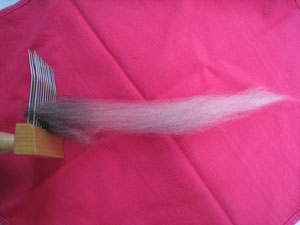 When combed, the white pulls out first, leaving the short and mostly grey behind on the comb. If I try to pull it all out into a single top, I will have long fibers at one end, and all the short fibers at the other, instead of nicely blended grey.
So, I think the best course of action for this is to pull off all the white and break the top. Then pull the remaining grey fiber off into a separate top. This way, I’ll have 2 completely different fibers from one combing.
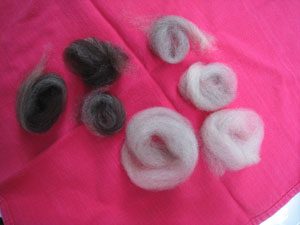 In the picture at right, the lower right nests are the first pull of primarily white. Some grey fibers came off with the white, but it is mostly white. The left are from the second pull. See how much darker it is without the white? The color is nearly black! The little grey nest at the center top is an “in-between.” I broke off the white because a lot of grey started to come out. In this one, I played with pulling the fiber off the comb in 3 steps: white, blended, and black. I don’t think I’ll be going this far with the final preparation, but it was an interesting experiment.
As a side note, the 2 different staples have the same hand. They are both lusciously soft.
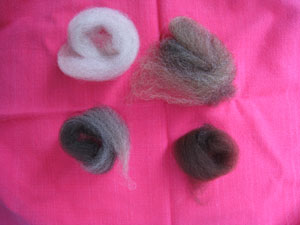 Also interesting is that the browner locks didn’t behave the same way. (see left) Yes, there were some slightly longer staples in the locks, but the difference between the staple length was not as dramatic. When combed, I wasn’t able to separate them out, so I just pulled them all off in a single top.
What is surprising is that the dark brown and the white/grey are all very soft. I would not mind wearing it against my skin. In fact, I wouldn’t mind rolling around in it! But the one on the top right? It feels very coarse to me. I will be separating this out when I sort out when I do the fiber prep.
So at least 3 different colors from one fleece that is next to the skin soft. More if I take extra time and effort. I think this would be really interesting for a color work sweater.
Bottom line? The fleece needs to be combed. I haven’t tried it on the big combs, but it may be necessary to use the hand combs to maintain control over the colors. And the final color sorting will need to happen after the combing. I’ll need to figure out a way of keeping the nests separate and uncompressed until I’m ready to spin. Yes, that means I need to figure out how to keep Ellie out of the combed fiber.
I’ll need to think about this more before I get started. But you know what? I can’t wait!
(Hmm…Does this count as sampling? I never realized that sampling was so much fun!)